
Unmanned reception,
smarter supplies.
From BankID-verified check-in to QR-controlled door access – everything you need to build an efficient, secure and GDPR-compliant guest experience.
In short: An unmanned reception is a self-service visitor solution where guests register digitally upon arrival. With modern features such as BankID verification og QR based door access can securely identify authorized guests and let them through doors and gates, without any manual handling. Properly implemented, it provides savings of several hundred thousand kroner annually, better compliance with GDPR and NIS2, and a more professional guest experience. This guide covers everything you need to know – from choosing a solution and screen placement, to BankID integration, door access, privacy and common pitfalls to avoid.
What is an unmanned reception?
An unmanned (or partially manned) reception is an automated visitor solution where guests check in themselves via a digital screen – without a receptionist having to be physically present. Instead of manual handling, a modern visitor management system (VMS) takes care of registration, host notification, visitor ticket printing, guest network access and other necessary information.
The solution is equally suitable for small offices as for large companies with thousands of visitors per month, and can be combined with a staffed reception during part of the opening hours.

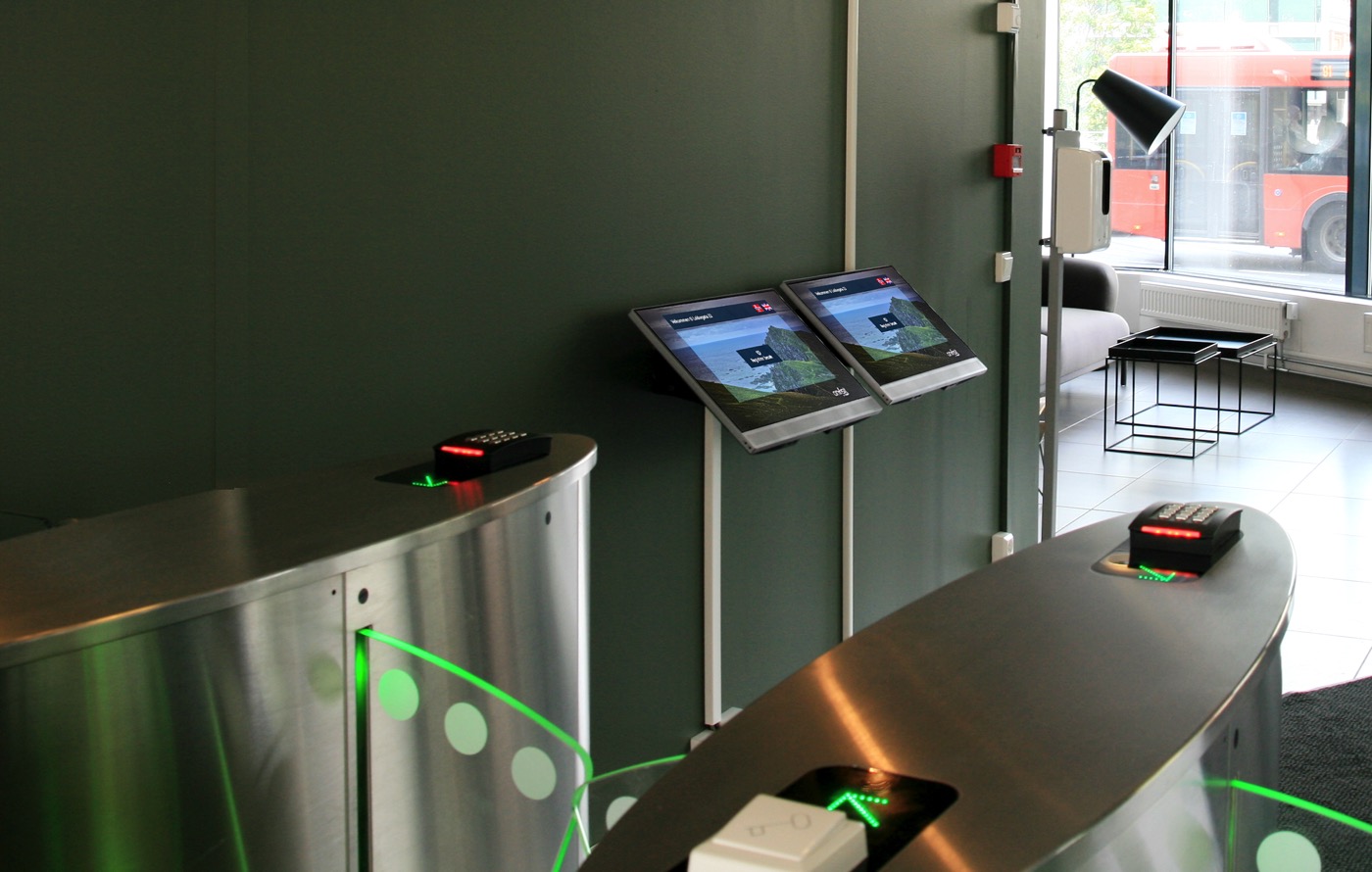
A well-visible and well-placed screen is a key to the success of an unmanned reception
Why are more and more businesses choosing unmanned reception?
Interest in unmanned receptions has increased significantly in recent years. Where the pandemic once accelerated digitalization, today cost-efficiency, security and compliance are at the top of the agenda.
Six main reasons to switch to an unmanned reception:
- Significant cost savings – a staffed reception typically costs 500,000–800,000 kroner per year
- Unleashed expertise – employees can spend their time on more value-added tasks than routine management
- Better compliance – digital guest log supports both GDPR and NIS2 traceability requirements
- Strong authentication – BankID verification provides secure identification of guests in sensitive environments
- Automatic access control – authorized guests can open doors and locks with a QR code
- Consistent guest experience – the same professional welcome regardless of the time or day of the week
From meeting booking to checked in – in 5 steps
The entire visitor flow happens automatically. The guest never has to wait – and you get full traceability.
Meeting room booked
In Outlook or Teams. External participants are automatically registered.
Invitation sent
Email with meeting details, map and personal QR code.
BankID verification
Optional – but mandatory for sensitive visits.
QR code is scanned
By screen, door or lock. Access time limited.
Host is notified
Via SMS or email. Guest picks up themselves.
This is what you need to get started
A well-functioning unmanned reception consists of four elements:
- A modern visitor management system (VMS) with a user-friendly interface
- A visible self-service screen located upon arrival
- Automatic host notification – via email or SMS
- A clear process for assistance when the guest needs it
5 tips for a successful unmanned reception
Tip 1: Place the screen where the guest sees it first
The most common mistake when implementing an unmanned reception is poor screen placement. The guest should not have to look for it. Follow these principles:
- The screen should be visible as soon as you enter the door.
- Use floor stand or wall mounted solution in open areas
- If you have had a reception desk before, this is a natural location – guests are already used to approaching you there.
- When partially staffed, the screen should be placed close to the receptionist so that help is easily available.

Tip 2 - Give guests what they actually need
The guest should be able to solve everything in one place. Map the needs of their visitors and build the solution around this. Typical features:
- Wi-Fi access via guest network service – no messing with passwords at the start of the meeting
- Delivery of goods who notifies one or more employees
- Help button who notifies one or more employees
- Real-time timetables for buses and trains (especially in public areas)
- Taxi booking where relevant
- Map and parking info
- Automatic SMS or email to the guest upon completion of registration:
"Hi Ola Nordmann. Welcome to us. Kari Nordkvinne has been notified of your arrival and will pick you up at the reception. Please help yourself to coffee while you wait."
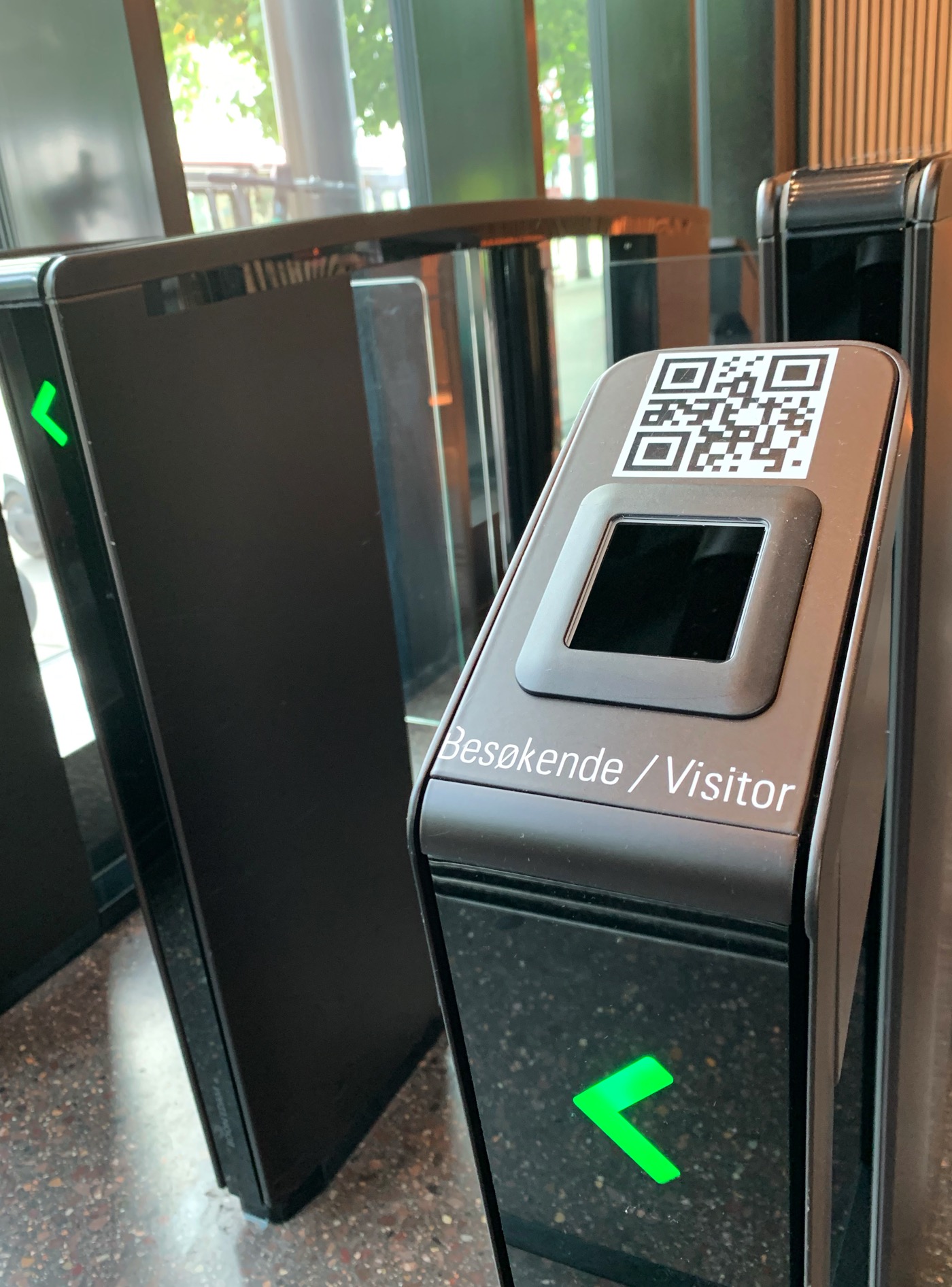
Tip 3 - Contactless check-in with QR code
A modern visitor system can automate the entire flow from meeting room booking to arrival. As soon as a meeting room is booked in Outlook or Teams, external participants are automatically pre-registered as guests – without any extra effort from the host. The rest of the flow then takes care of itself:
- The meeting room is booked, and external participants are automatically registered as guests.
- The guest receives a confirmation and can pre-fill personal data
- Just before arrival, you will receive a new email with meeting details, parking information, map and QR code.
- Upon arrival, the QR code is scanned, the guest is checked in in seconds
The result: The guest is impressed, the host is automatically notified, and the entire registration process takes less time than taking off your outer jacket.
Tip 4: Build in GDPR and NIS2 compliance from day one
This is the point most people underestimate. Unmanned reception is not just about technology – it's about how personal data is handled.
GDPR requirements for visitor registration:
- Guest logs should not be visible to others (forget paper books on the counter)
- Personal data shall be stored securely and deleted automatically after the retention period.
- The guest must be informed about how the data is processed.
NIS2 relevance:
For businesses covered by the NIS2 directive, logging physical access is part of the security requirements. A modern visitor system provides documentation and traceability that supports these requirements – and makes supplier assessments easier.
Read more about how you take your guest's personal data seriously.
Tip 5: Start with partial staffing – don’t go completely unmanned on day one
The quickest way to a bad first impression is to throw the receptionist out immediately. Recommended approach:
- Introduce self-service with a receptionist present for 2–4 weeks
- Observe what guests struggle with and adjust the solution
- Gradually transition to fully unmanned – possibly with partial staffing during peak hours
This provides both a safer transition and a better end result.
Advanced security: BankID verification and door access via QR code
For businesses with higher security requirements – banking, finance, healthcare, defense, the public sector or buildings with controlled zoning – standard self-registration is not always enough. Modern visitor systems can now combine strong electronic ID control with automated access control , so that the entire flow from identification to entry is digital.
BankID verification of the guest's identity
By integrating BankID into the check-in flow, you can require verified identity before a guest can proceed. This is especially relevant when:
- Sensitive visit purposes – customer meetings at a bank, lawyer or healthcare services
- Security-cleared areas – buildings and premises with controlled access
- Deliveries and craftsmen – when it is important to document who was actually present
- NIS2-regulated businesses – where strong authentication of external parties is part of the security regime
BankID login provides legally binding identification at the highest level of trust (eIDAS High), replacing manual ID checks at the reception. The guest can verify themselves on their own mobile upon arrival, or in advance through the invitation link – without an employee having to manually check their passport or driver's license. The result is faster flow, more secure documentation and less friction.
Door access and locks via QR code
Once the guest is authorized – through pre-invitation, BankID or manual approval – the same QR code used for check-in can also open doors, gates and locks along the way. Typical uses:
- Main entrance and vestibules outside opening hours
- Sluices and doors for office floors or security zones
- Parking barriers for pre-registered guests
- Meeting room areas where access should be limited to invited guests
Access is time-limited and tied to the specific visit – the QR code only works in a defined time window around the agreed meeting time, and is automatically deactivated after check-out. This gives you full control and traceability, while the guest does not have to wait for someone to pick them up.
The solution integrates with your existing access control system so you don't have to rebuild your infrastructure. All events are logged in the visitor system and can be exported for auditing - important for both NIS2, ISO 27001 and internal security monitoring.
Avoid these traps
As with all changes, it is also possible to make mistakes here. Fortunately, there are several who have made this transition before you, and we can share some experiences.
 Taking personal data too lightly
An open guestbook on the counter is a GDPR nightmare in 2026. Provide confidentiality to guests and document that the processing is in line with the regulations. This also applies to internal logs - access must be controlled.
Spreading functions outwards
One screen for registration, one tablet for taxis, one screen for timetables, a brochure next to it – the result is confusing for the guest. Collect as much as possible in the visitor system itself, and possibly supplement it with one info screen that guests can look at while they wait.
Hasty transition to unmanned reception
You never get to make a first impression again. Take the time to understand your guests' needs and test the solution before going completely unmanned.
Frequently asked questions about unmanned reception
How much can we save by switching to an unmanned reception?
The savings depend on current staffing and visitor volume, but many businesses save between NOK 300,000 and 700,000 annually when calculating salaries, absences, training and recruitment.
Is unmanned reception compatible with GDPR?
Yes. A modern digital solution is often better at protecting privacy than a paper-based guestbook, provided that the visitor system processes personal data in accordance with regulations and has automatic deletion.
What about NIS2 – does a visitor system meet the requirements there?
The visitor system is not sufficient on its own, but contributes significantly to compliance through logging of physical access, traceability and documentation – all key elements of NIS2.
What do we do with guests who are not digital?
onVisit has simple self-registration that works for everyone. Combine it with a clear help button that alerts an employee, or staffing for parts of the day.
How long does it take to set up an unmanned reception desk?
The actual technical setup can be done in a few days, but we recommend 2–6 weeks with partial staffing for best results.
How are evacuation and fire handled?
A digital visitor system provides a real-time overview of who is in the building – a major security advantage compared to manual solutions.
Can unmanned reception integrate with Outlook and Teams?
Yes. onVisit integrates with Microsoft 365, so meeting invitations automatically start the visitor flow – from invitation to check-in.
Can we require BankID verification from guests?
Yes. The visitor system can require BankID login before check-in is completed, either on the guest's own mobile or via a terminal at the reception. This provides legally binding identification at the eIDAS High level and is particularly useful for banking, finance, healthcare and NIS2-regulated businesses.
How does door access via QR code work?
Authorized guests receive a QR code that – in addition to check-in – can open specific doors, gates and parking barriers. Access is time-limited to the visitor window and is automatically deactivated upon check-out. The solution integrates with existing access control systems such as ASSA ABLOY, Security Expert and OnGuard.
What happens if the guest does not have BankID?
You can configure alternative verification methods with manual approval from the host for guests without a Norwegian BankID. The system can also be set up to require BankID only for selected visit purposes.
Want to know more and get personal advice?
Book a free guide with one of our experienced experts. Get feedback on how you can build the most efficient and attentive unmanned reception as possible!
also read
